 Posted by
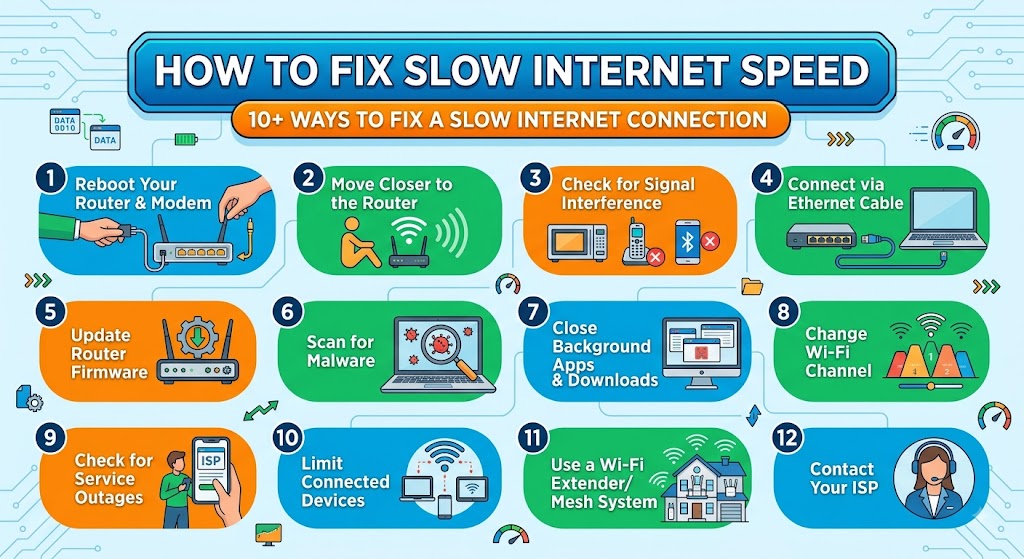
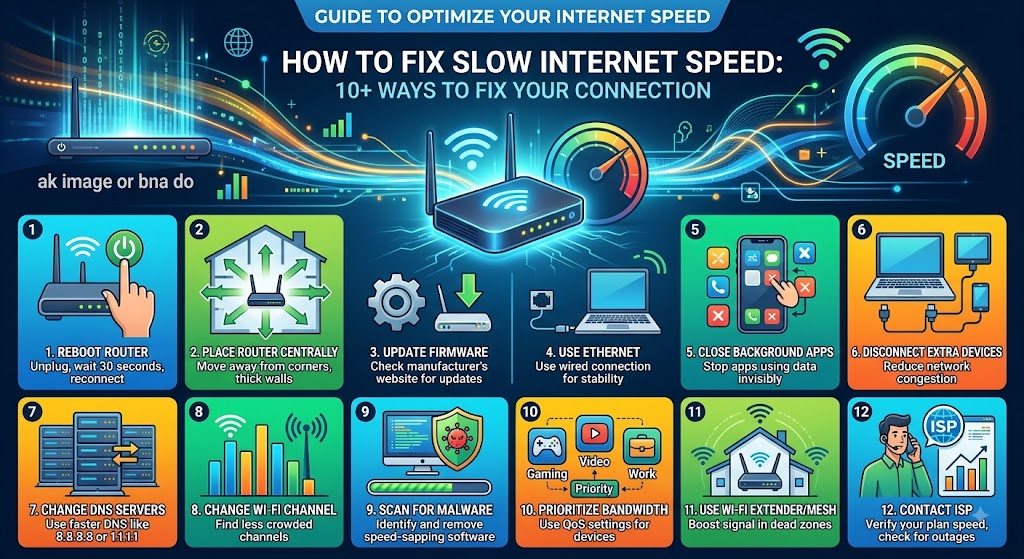
 How to Fix Slow Internet Speed: 10+ Ways to Fix a Slow Internet Connection
Learn how to fix slow internet speed, troubleshoot a slow internet connection, improve Wi-Fi performance, and fix slow internet speed on Windows 11 laptops and computers.
fix slow internet speed
fix slow internet connection
troubleshoot slow internet connection
fix bad internet connection
permanently fix slow internet speed on Windows computer
my internet speed has slowed down
how to fix slow internet speed in laptop
fix slow internet speed Windows 11
fix slow internet speed
SEO Title: How to Fix Slow Internet Speed on Windows 11, Laptop & PC
Meta Description:
How to fix slow internet connection
A slow internet connection can make almost everything frustrating. Web pages take longer to load, YouTube videos buffer, downloads become extremely slow, video calls may disconnect, and online games can experience high latency.
If you are thinking, “My internet speed has slowed down,” the problem may not necessarily be your internet service provider. Slow internet can be caused by your Wi-Fi signal, router, computer, background applications, DNS settings, network drivers, Windows configuration, or even a problem with the website or server you are trying to access.
The good news is that many slow internet problems can be fixed without replacing your computer or upgrading your internet plan.
This guide explains how to fix slow internet speed, troubleshoot your connection, and improve internet performance on Windows 11, laptops, and desktop computers.
Why Is My Internet So Slow?
Before trying complicated solutions, it is important to identify what is causing the slowdown.
Common causes include:
- Weak Wi-Fi signal
- Too much distance between the router and computer
- Too many devices using the same connection
- Router or modem problems
- Background downloads
- Windows updates
- Cloud synchronization
- Malware or unwanted software
- Outdated network drivers
- Incorrect network configuration
- DNS problems
- VPN or proxy connections
- ISP congestion or service problems
- Damaged Ethernet cables
- Interference from other wireless devices
If your internet suddenly became slow, start with the simplest troubleshooting steps first.
1. Check Your Internet Speed
The first step is to determine whether your internet connection is actually slow.
Run an internet speed test and compare the result with the speed included in your internet plan.
Check:
- Download speed
- Upload speed
- Ping/latency
For example, if your plan provides 100 Mbps but your computer consistently receives only 10–20 Mbps under similar conditions, there may be a connection problem.
However, remember that speed-test results can vary depending on the server, time of day, Wi-Fi signal, network traffic, and the device being tested.
2. Restart Your Router and Modem
One of the easiest ways to fix a slow internet connection is to restart your networking equipment.
Turn off your router and modem or gateway device.
Wait for approximately 30–60 seconds, then turn them back on.
Allow the devices a few minutes to reconnect to your ISP.
Then test your internet speed again.
A restart can clear temporary connection problems and may resolve performance issues caused by the router or modem.
3. Restart Your Windows Computer
Sometimes the problem is not the internet connection itself but the computer’s network configuration.
Restarting Windows can close applications and background processes that may be consuming bandwidth.
If your laptop has been running for several days without a restart, rebooting it is a simple troubleshooting step worth trying.
4. Move Closer to the Wi-Fi Router
If you are using Wi-Fi, distance can have a major effect on performance.
Walls, floors, furniture, appliances, and other obstacles can weaken the wireless signal.
If possible:
- Move closer to the router.
- Place the router in a central location.
- Keep the router away from large metal objects.
- Avoid placing it inside a cabinet.
- Keep it away from sources of wireless interference.
If your internet becomes significantly faster when you move closer to the router, your Wi-Fi signal is likely part of the problem.
5. Try a 5 GHz or 6 GHz Wi-Fi Network
Modern routers may support multiple Wi-Fi bands.
Depending on your router and device, you may see networks associated with:
- 2.4 GHz
- 5 GHz
- 6 GHz
The 2.4 GHz band generally provides better range but can be more congested.
5 GHz can provide higher speeds at shorter distances.
6 GHz, when supported by compatible devices and routers, can provide access to newer Wi-Fi spectrum and potentially better performance in suitable conditions.
If your computer is close to the router, try the faster available band and compare the results.
6. Disconnect Devices You Are Not Using
Your internet connection is shared among connected devices.
For example, your network might include:
- Smartphones
- Smart TVs
- Laptops
- Desktop computers
- Tablets
- Security cameras
- Gaming consoles
- Streaming devices
If several devices are downloading large files or streaming high-resolution video simultaneously, your available bandwidth can decrease.
Disconnect devices you do not need and test your internet connection again.
7. Check for Background Downloads
If my internet speed has slowed down, check whether your computer is downloading or uploading something in the background.
Common bandwidth-consuming activities include:
- Windows updates
- Game updates
- Cloud backups
- OneDrive synchronization
- Google Drive synchronization
- Large file downloads
- Torrent applications
- Software updates
Open Task Manager in Windows and look for applications using significant network resources.
Press:
Ctrl + Shift + Esc
Then review the running processes and network activity.
If a legitimate application is using a large amount of bandwidth, allow the activity to finish or pause the download if appropriate.
8. Disable a VPN Temporarily
A VPN can sometimes reduce internet speed because your traffic is routed through an additional server.
If you are using a VPN and your connection suddenly became slow, temporarily disconnect it and perform another speed test.
If your normal internet speed returns after disconnecting the VPN, the VPN server, protocol, distance, or network conditions may be contributing to the slowdown.
Do not disable security software unnecessarily; this test is specifically for a VPN connection.
9. Check Your Ethernet Cable
If your computer uses a wired Ethernet connection, inspect the cable.
A damaged or poor-quality cable can cause connection problems or limit network performance.
Try:
- Disconnecting the Ethernet cable.
- Checking both connectors.
- Reconnecting it firmly.
- Trying another Ethernet cable if available.
- Testing another router port if appropriate.
A wired connection is often more stable than Wi-Fi, so Ethernet can also be a useful way to determine whether your problem is related to wireless connectivity.
10. Restart Windows Network Settings
If you want to fix slow internet speed Windows 11, resetting the network configuration can sometimes help when Windows has a corrupted or incorrect network setting.
Open:
Settings → Network & internet → Advanced network settings
Depending on your Windows version, you can find options for managing network adapters and resetting network settings.
Windows also provides a Network reset option.
Keep in mind that a network reset can remove saved network information and reinstall network adapters, so use it after simpler troubleshooting steps.
You may need to reconnect to your Wi-Fi network afterward.
11. Update Your Network Driver
An outdated or malfunctioning Wi-Fi or Ethernet driver can cause connection problems.
To check your driver:
- Right-click the Start button.
- Open Device Manager.
- Expand Network adapters.
- Locate your Wi-Fi or Ethernet adapter.
- Check for driver updates.
You can also check the computer manufacturer’s support website for the latest driver designed for your specific laptop or motherboard.
Avoid downloading drivers from unknown websites.
How to start a website
12. Troubleshoot the Network Connection in Windows 11
Windows includes built-in troubleshooting tools that can help identify common network problems.
Open:
Settings → System → Troubleshoot → Other troubleshooters
Look for the available network or internet-related troubleshooter options on your Windows version.
Windows may check for problems involving network adapters, connectivity, or configuration.
This can be particularly useful if your computer says it is connected to Wi-Fi but websites are not loading correctly.
13. Flush the DNS Cache
DNS translates domain names into IP addresses.
For example, when you enter a website address into your browser, DNS helps your computer find the appropriate server.
A corrupted or outdated DNS cache can sometimes contribute to connection problems.
To clear the DNS cache:
- Open Command Prompt as Administrator.
- Enter:
ipconfig /flushdns- Press Enter.
- Restart your browser and test the connection.
You should see a message confirming that the DNS Resolver Cache was successfully flushed.
14. Renew Your IP Address
Windows can also renew its IP address.
Open Command Prompt as Administrator and run:
ipconfig /releaseThen run:
ipconfig /renewAfter the process completes, test your connection again.
This can help when the computer has a temporary IP configuration problem.
15. Reset the TCP/IP Stack
If basic troubleshooting does not work, resetting the Windows TCP/IP networking stack may help with certain configuration problems.
Open Command Prompt as Administrator and run:
netsh int ip resetThen restart your computer.
This is a more advanced troubleshooting step, so it is better to try the simpler solutions first.
16. Check Your Browser
Sometimes the internet connection is fine but the browser is slow.
Try opening the same website in another browser.
For example:
- Chrome
- Microsoft Edge
- Firefox
If one browser is slow while another works normally, the problem may be related to the browser.
You can try:
- Disabling unnecessary extensions
- Clearing cached data
- Updating the browser
- Closing unused tabs
- Creating a new browser profile
Be careful when removing cookies or site data because doing so can sign you out of websites.
17. Scan Your Computer for Malware
Malware can sometimes consume network resources or interfere with normal computer operation.
If your internet has become unusually slow along with other strange computer behavior, run a security scan using trusted security software.
Windows includes built-in security protection that can be used to scan your computer.
Avoid installing random “internet speed booster” applications. Many provide little benefit and some may create additional security or performance problems.
18. Check Whether the Problem Is With Your ISP
If your internet is slow on every device connected to your network, the problem may be outside your computer.
For example:
Phone → Slow
Laptop → Slow
Smart TV → Slow
This suggests the problem could involve your router, modem, Wi-Fi network, or ISP.
Contact your internet provider if:
- Your speed remains consistently below the expected level.
- Your connection frequently disconnects.
- The problem affects multiple devices.
- Your router shows an unusual connection status.
- There is a known outage in your area.
Your ISP can check the connection from its side and determine whether there is a line or service problem.
How to Permanently Fix Slow Internet Speed on a Windows Computer
There is no single permanent solution because slow internet can have many different causes.
However, you can greatly reduce recurring problems by following these practices:
- Keep Windows updated.
- Keep your network drivers updated.
- Place your Wi-Fi router in a suitable location.
- Use Ethernet when maximum stability is important.
- Use an appropriate Wi-Fi band.
- Remove unnecessary background applications.
- Keep your router firmware updated when updates are provided by the manufacturer.
- Secure your Wi-Fi network with a strong password.
- Monitor devices connected to your network.
- Replace damaged Ethernet cables.
- Avoid unnecessary VPN use when speed is the priority.
- Check your internet plan if your household regularly exceeds its available bandwidth.
These steps can help permanently fix slow internet speed on Windows computer when the underlying cause is within your local network or computer.
How to Fix Slow Internet Speed on a Laptop
If you want to know how to fix slow internet speed in laptop, start with these steps:
Quick laptop checklist
1. Restart the laptop.
2. Restart the router.
3. Move closer to the Wi-Fi router.
4. Disconnect unnecessary VPN connections.
5. Check Task Manager for downloads.
6. Update the Wi-Fi driver.
7. Test another Wi-Fi network.
8. Run a Windows network troubleshooter.
9. Flush the DNS cache.
10. Compare the laptop’s speed with another device.
If another device gets normal speeds on the same Wi-Fi network while your laptop remains slow, the laptop itself is more likely to be the source of the problem.
How to Fix a Bad Internet Connection
If your connection repeatedly disconnects instead of simply being slow, troubleshoot it differently.
Check:
- Router placement
- Wi-Fi signal strength
- Ethernet cable
- Router temperature and ventilation
- Network adapter
- Wi-Fi drivers
- ISP service
- Interference
- Connected devices
If possible, test your computer using Ethernet.
If Ethernet works reliably but Wi-Fi does not, the issue is likely related to the wireless connection rather than your internet service itself.
Quick Troubleshooting Checklist
If you need to troubleshoot a slow internet connection quickly, follow this order:
- Run a speed test.
- Restart your router.
- Restart your computer.
- Move closer to the router.
- Disconnect unused devices.
- Check background downloads.
- Disable VPN temporarily.
- Test another browser.
- Update your network driver.
- Flush DNS.
- Reset network settings if necessary.
- Contact your ISP if every device is slow.
This order helps you start with simple solutions before moving to advanced troubleshooting.
Frequently Asked Questions
Why did my internet speed suddenly become slow?
A sudden slowdown can be caused by router problems, ISP congestion or outages, background downloads, Windows updates, Wi-Fi interference, VPN usage, or problems with your computer’s network configuration.
How can I fix slow internet speed on Windows 11?
Restart your router and computer, check background network usage, test your Wi-Fi signal, update the network driver, use Windows network troubleshooting tools, and reset network settings if necessary.
Why is my laptop internet slow but my phone is fast?
If your phone is fast on the same Wi-Fi network but your laptop is slow, the problem may be related to the laptop’s Wi-Fi adapter, driver, network configuration, signal strength, or background applications.
Does restarting the router improve internet speed?
Restarting the router can resolve temporary connection or networking problems. However, it will not permanently increase the speed provided by your ISP.
Does DNS change internet speed?
Changing DNS servers can sometimes improve how quickly websites begin connecting, particularly when the existing DNS service is slow or unreliable. However, DNS changes generally do not increase the actual bandwidth of your internet connection.
Can a VPN make internet slower?
Yes. A VPN can add processing and routing overhead, and the distance or load of the VPN server can affect performance.
Should I buy a new router if my internet is slow?
Not necessarily. First determine whether the problem is the router, Wi-Fi signal, computer, ISP, or available bandwidth. Replacing the router may not help if the actual problem is your ISP connection or computer.
Final Thoughts
When my internet speed has slowed down, the best approach is to troubleshoot the connection systematically rather than immediately buying new equipment or upgrading your internet plan.
Start by testing your speed, restarting your router and computer, checking Wi-Fi signal strength, and looking for background downloads. If the problem continues, move on to network drivers, DNS, Windows network settings, and other advanced troubleshooting steps.
For Windows 11 users, these methods can help you fix slow internet speed Windows 11, improve Wi-Fi performance, and identify whether the problem is coming from your laptop, router, network, or internet provider.
The most important thing is to identify the cause first. Once you know whether the slowdown is caused by Wi-Fi, Windows, your router, or your ISP, you can apply the appropriate solution instead of trying random fixes.
- what is technical seo Audit: The Complete Technical SEO Audit Checklist
- Best 8 way fix slow upload speed on both mobile and PC/laptop
- How to redirect post wordpress | redirect post meaning
- how to open trump account for Kids : $1,000 Trump Account Explained
- How to Fix Slow Internet Speed: 10+ Ways to Fix a Slow Internet Connection