 Posted by
 aws amazon certification cost | AWS Amazon.com Certification: The Complete Beginner’s Guide to Building a Successful Cloud Career
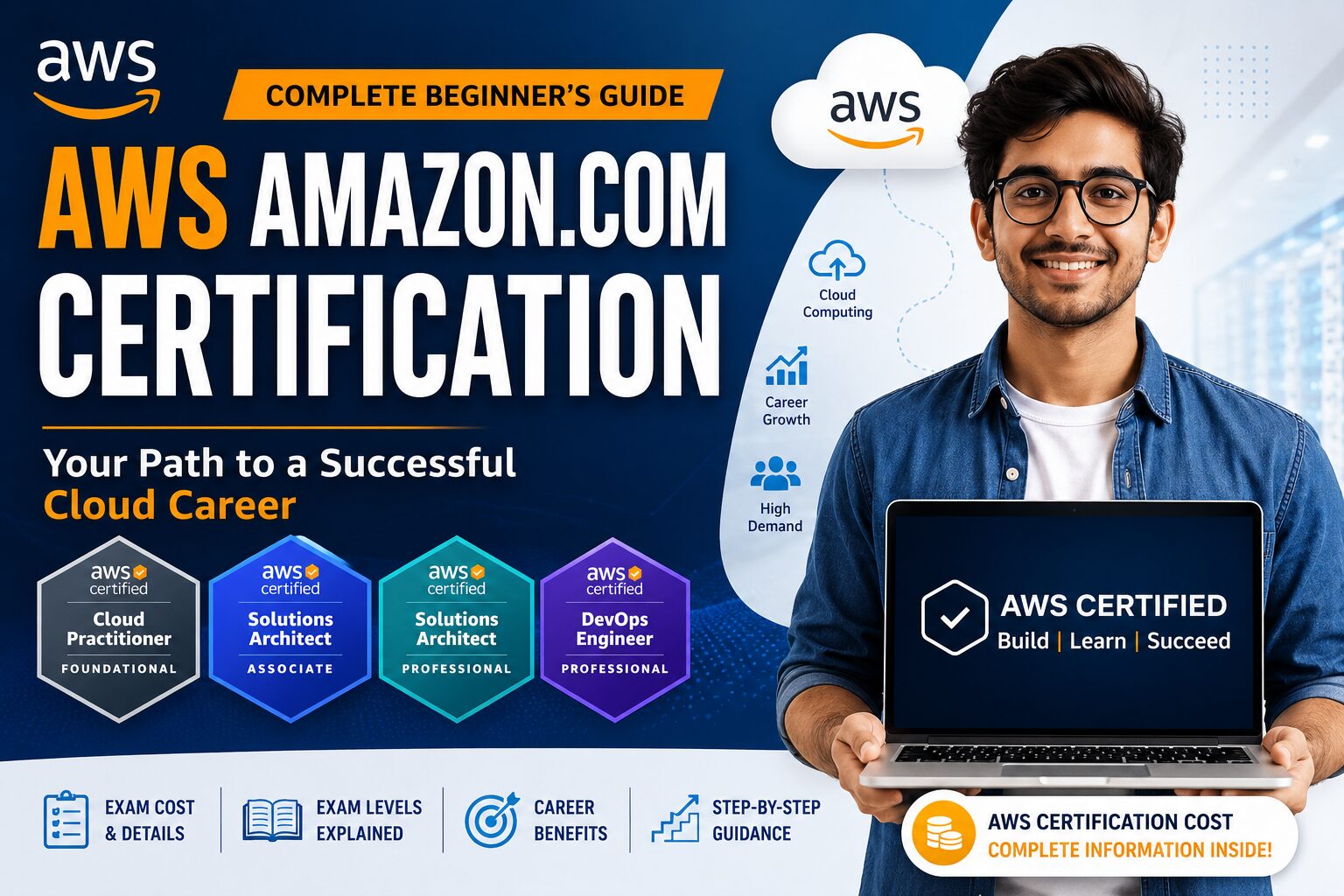
Want to pass your aws amazon certification? Check out this beginner’s guide covering exam roadmaps, preparation strategies, and actual exam costs ($100–$300).
amazon cloud certification cost
Here is the standard pricing for AWS (Amazon Web Services) certification exams:
| Certification Level | Exam Fee (USD) | Example Exams |
| Foundational | $100 (~₹8,500) | AWS Certified Cloud Practitioner / AI Practitioner |
| Associate | $150 (~₹12,800) | Solutions Architect, Developer, SysOps Administrator |
| Professional | $300 (~₹25,600) | Solutions Architect Pro, DevOps Engineer Pro |
| Specialty | $300 (~₹25,600) | Security, Machine Learning, Advanced Networking |
Key Things to Know
- 50% Discount Voucher: Every time you pass an AWS exam, you receive a 50% off voucher in your AWS Certification account to use on your next exam.
- Practice Exams: Official practice exams usually cost between $20 to $40.
- Taxes: Local taxes (e.g., GST/VAT) may be added depending on your country.
- What Is AWS Amazon.com Certification?
- Why AWS Certification Matters
- Who Should Get AWS Certified?
- Benefits of AWS Amazon.com Certification
- AWS Certification Roadmap for Beginners
- AWS Certification Learning Path
- Career Opportunities After AWS Certification
- Industries Hiring AWS Professionals
- Common Beginner Mistakes
- How to Prepare for an AWS Amazon.com Certification Exam
- Best Learning Resources for AWS Certification
- Common Challenges Faced by Beginners
- Salary Expectations After AWS Certification
- Companies Hiring AWS-Certified Professionals
- Frequently Asked Questions
- Final Thoughts
Suggested Image:
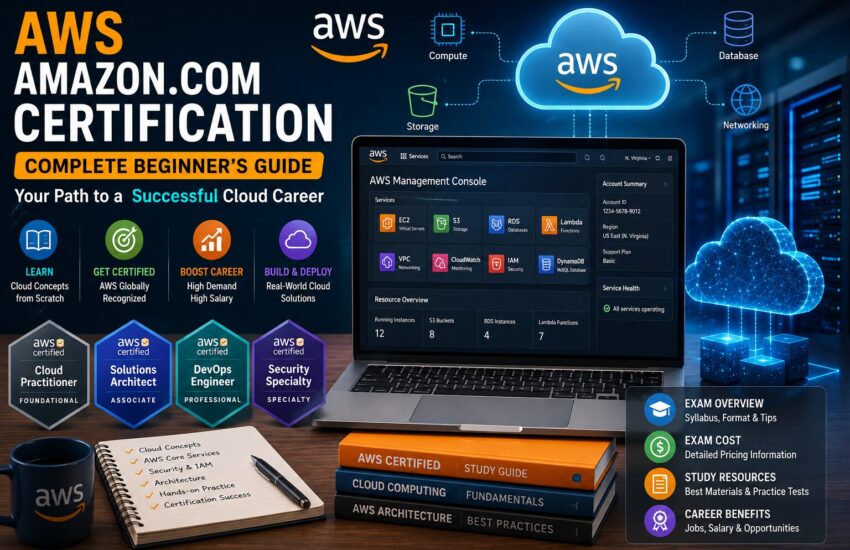
A professional illustration showing cloud computing, Amazon Web Services dashboard, laptop, servers, networking icons, and cloud architecture.
Image ALT Text:
AWS Amazon.com Certification Guide
what is aws certification
Cloud computing has transformed the technology industry, and Amazon Web Services (AWS) has become one of the world’s leading cloud platforms. Businesses of every size—from startups to global enterprises—use AWS to host websites, run applications, store data, build AI solutions, and manage secure cloud infrastructure.
An AWS Amazon.com Certification is an official credential offered by Amazon Web Services that validates your knowledge of AWS cloud technologies. It demonstrates to employers that you understand how AWS services work and how to build secure, scalable, and reliable cloud solutions.
Unlike many online certificates that simply confirm course completion, AWS certifications require you to pass a professional examination. This makes them highly respected by employers and recruiters across the world.
Whether you are a student, software developer, system administrator, IT support engineer, network specialist, DevOps professional, or someone looking to switch careers, AWS certification can help you build a strong foundation in cloud computing.
How to redirect posts WordPress
Why AWS Certification Matters
Cloud technology is now used in almost every industry. Banks, hospitals, universities, government organizations, e-commerce companies, media platforms, gaming companies, and software businesses rely on cloud infrastructure every day.
Because of this rapid adoption, companies are actively looking for professionals who understand AWS services and can confidently work with cloud environments.
AWS certification provides several important advantages:
- Demonstrates verified cloud knowledge.
- Improves your resume and LinkedIn profile.
- Helps you qualify for cloud-related job roles.
- Builds confidence when working with AWS services.
- Shows employers that you are committed to professional development.
- Helps you understand cloud security, networking, storage, and computing services.
- Opens opportunities for freelance, remote, and international work.
Many hiring managers use AWS certification as one of the factors when evaluating candidates for cloud and infrastructure roles.
Who Should Get AWS Certified?
One of the biggest advantages of AWS certification is that it is suitable for learners with different backgrounds.
You may benefit from AWS certification if you are:
- A college or university student interested in cloud computing.
- A software developer building web or mobile applications.
- A Linux or Windows system administrator.
- A DevOps engineer working with automation and CI/CD.
- A cybersecurity professional securing cloud environments.
- A network engineer managing enterprise infrastructure.
- A database administrator migrating workloads to the cloud.
- A business analyst working with cloud solutions.
- A project manager overseeing cloud migration projects.
- A freelancer looking to expand technical services.
- An entrepreneur building SaaS or online businesses.
Even if you have no previous cloud experience, AWS offers beginner-friendly learning paths that gradually introduce core cloud concepts before moving to advanced topics.
Benefits of AWS Amazon.com Certification
Earning an AWS certification offers both short-term and long-term career benefits.
Industry Recognition
AWS certifications are recognized globally. Recruiters and employers understand the value of AWS credentials because they are issued directly by Amazon Web Services.
Better Career Opportunities
Organizations across multiple industries hire AWS-certified professionals for cloud engineering, architecture, operations, development, and security roles.
link
Related Article:
Types of AWS Certifications
Suggested URL:
/types-of-aws-certifications/
Higher Salary Potential
Many cloud professionals report competitive salaries because cloud computing skills remain in high demand. While salary depends on your experience, location, and role, AWS certification can strengthen your profile during hiring and promotion discussions.
Practical Knowledge
Preparing for AWS certification encourages hands-on learning. You’ll gain experience using services such as virtual servers, cloud storage, databases, networking, monitoring, and identity management.
This practical experience is valuable not only for passing the exam but also for solving real-world business challenges.
Career Flexibility
Cloud computing skills are transferable across industries. Whether you work in healthcare, education, finance, retail, manufacturing, or technology, AWS knowledge can be applied in many environments.
📷 IMAGE 3 HERE
Suggested Image:
Cloud engineer working with AWS dashboard on multiple screens.
Image ALT Text:
AWS Cloud Engineer
AWS Certification Roadmap for Beginners
If you are starting from scratch, following a structured roadmap will make learning easier.
Step 1: Learn Cloud Fundamentals
Understand what cloud computing is, why organizations use it, and how public, private, and hybrid cloud environments differ.
Step 2: Create an AWS Free Tier Account
Use the AWS Free Tier to explore services and gain practical experience. Experiment with launching virtual machines, storing files, and managing cloud resources while staying within the free usage limits.
Step 3: Learn Core AWS Services
Focus on foundational services such as:
- Amazon EC2
- Amazon S3
- Amazon RDS
- AWS IAM
- Amazon VPC
- AWS Lambda
- Amazon CloudWatch
- Amazon Route 53
Understanding these services will prepare you for more advanced AWS concepts and certifications.
🔗 INTERNAL LINK
Related Article:
AWS Amazon Certification Cost
Suggested URL:
/aws-amazon-certification-cost/
AWS Amazon.com Certification: The Complete Beginner’s Guide to Building a Successful Cloud Career (Part 2)
Essential AWS Services Every Beginner Should Learn
One of the biggest mistakes beginners make is trying to learn every AWS service at once. Amazon Web Services offers more than 200 cloud services, but you only need to master a small group of core services before moving to advanced topics.
Understanding these services will also make your AWS certification journey much easier.
Amazon EC2 (Elastic Compute Cloud)
Amazon EC2 is one of the most popular AWS services. It allows users to launch virtual servers in the cloud within minutes.
Instead of buying expensive physical hardware, businesses can simply rent virtual machines according to their requirements.
Some common use cases include:
- Hosting websites
- Running enterprise software
- Application development
- Testing environments
- Gaming servers
- AI applications
📷 IMAGE 4 HERE
Suggested Image
AWS EC2 Dashboard Screenshot
ALT Text
Amazon EC2 Virtual Server Dashboard
Amazon S3 (Simple Storage Service)
Amazon S3 is AWS’s cloud storage platform.
Millions of companies use Amazon S3 to store:
- Images
- Videos
- Documents
- Website backups
- Software packages
- Data archives
Amazon S3 is highly durable, scalable, and secure.
Many businesses also use it for disaster recovery because files remain safely stored even if a local server fails.
AWS IAM (Identity and Access Management)
Security is extremely important in cloud computing.
AWS IAM helps organizations control who can access cloud resources.
Using IAM, administrators can:
- Create users
- Create groups
- Assign permissions
- Enable Multi-Factor Authentication (MFA)
- Secure AWS accounts
Understanding IAM is essential for every AWS certification exam.
Amazon RDS
Amazon Relational Database Service (RDS) simplifies database management.
Instead of manually maintaining database servers, AWS automatically handles:
- Backups
- Security updates
- Scaling
- High availability
- Monitoring
Popular database engines include:
- MySQL
- PostgreSQL
- MariaDB
- SQL Server
AWS Lambda
AWS Lambda is one of AWS’s most innovative services.
It allows developers to run code without managing servers.
This approach is known as Serverless Computing.
Advantages include:
- No server maintenance
- Automatic scaling
- Pay only for execution time
- Faster application development
📷 IMAGE 5 HERE
Suggested Image
AWS Lambda Workflow Diagram
ALT Text
AWS Serverless Architecture
Skills You Should Learn Before Taking AWS Certification
Although AWS certifications are beginner-friendly, learning these skills first will make the journey much easier.
Basic Networking
Understanding concepts like:
- IP Address
- DNS
- HTTP
- HTTPS
- Firewall
- VPN
- Load Balancer
will help you understand AWS networking services.
Linux Basics
Many AWS servers run Linux.
Learning simple Linux commands such as:
- ls
- pwd
- cd
- mkdir
- chmod
- top
- df
can be extremely useful.
Cloud Computing Concepts
You should understand:
- Public Cloud
- Private Cloud
- Hybrid Cloud
- Multi Cloud
- Scalability
- High Availability
- Disaster Recovery
These topics appear frequently in AWS certification exams.
Security Fundamentals
Cloud security is another important topic.
Learn about:
- Encryption
- Authentication
- Authorization
- Identity Management
- SSL Certificates
- Data Protection
🔗 INTERNAL LINK
Related Guide
AWS Certificate Manager
Suggested URL
/aws-certificate-manager/
AWS Certification Learning Path
If you’re completely new to cloud computing, follow this roadmap.
Month 1
Learn:
- Cloud Computing Basics
- Networking
- Linux Fundamentals
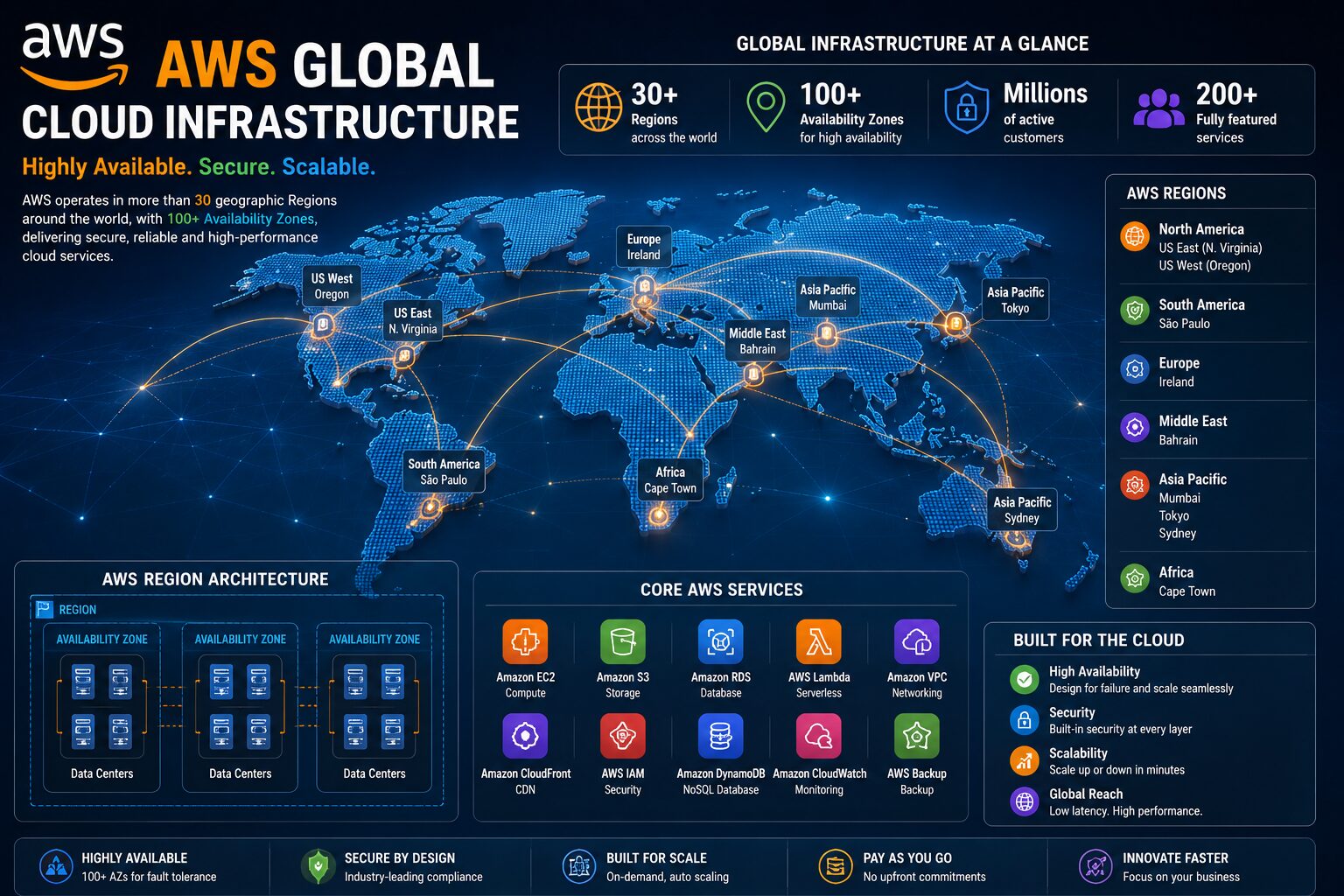
- AWS Global Infrastructure
Practice using AWS Free Tier.
Month 2
Study core AWS services:
- EC2
- S3
- IAM
- RDS
- VPC
- Route 53
- CloudWatch
Complete small hands-on projects.
Month 3
Start preparing specifically for the AWS Certified Cloud Practitioner exam.
Take mock tests.
Review weak areas.
Practice every day.
Month 4
Book your certification exam.
Revise official AWS documentation.
Complete practice exams.
Pass your first AWS certification.
📷 IMAGE 6 HERE
Suggested Image
AWS Learning Roadmap Timeline
ALT Text
AWS Certification Roadmap
Career Opportunities After AWS Certification
Cloud computing continues to create opportunities across many industries.
Some popular job roles include:
Cloud Engineer
Design, deploy, and maintain cloud infrastructure.
Average responsibilities include:
- Server deployment
- Cloud migration
- Monitoring
- Cost optimization
AWS Solutions Architect
Architects design complete cloud solutions for organizations.
Responsibilities include:
- Infrastructure planning
- Security architecture
- High availability
- Disaster recovery
- Cost management
This role is considered one of the most respected cloud careers.
DevOps Engineer
DevOps engineers automate software deployment.
They commonly work with:
- AWS
- Docker
- Kubernetes
- Jenkins
- GitHub Actions
- Terraform
AWS certification provides an excellent foundation for DevOps careers.
Cloud Security Engineer
Security engineers protect cloud infrastructure.
Responsibilities include:
- IAM Policies
- Encryption
- Compliance
- Threat Monitoring
- Security Audits
Cloud Support Engineer
Support engineers troubleshoot AWS environments.
Tasks include:
- Customer support
- Network troubleshooting
- Database issues
- Server management
🔗 INTERNAL LINK
Related Guide
AWS Amazon.com Jobs
Suggested URL
/aws-amazon-com-jobs/
Industries Hiring AWS Professionals
AWS-certified professionals work across many industries.
These include:
- Banking
- Healthcare
- Government
- Education
- Retail
- E-commerce
- Artificial Intelligence
- FinTech
- Media
- Gaming
- Manufacturing
- Logistics
- Telecommunications
Cloud computing skills are now valuable in almost every business sector.
Common Beginner Mistakes
Avoid these mistakes:
❌ Memorizing instead of practicing
❌ Skipping AWS documentation
❌ Ignoring IAM
❌ Not using AWS Free Tier
❌ Studying too many services at once
❌ Avoiding practice exams
❌ Learning without building projects
Hands-on experience is one of the best ways to prepare for AWS certification and future job interviews.
AWS Amazon.com Certification: The Complete Beginner’s Guide to Building a Successful Cloud Career (Part 3)
How to Prepare for an AWS Amazon.com Certification Exam
Preparing for an AWS certification exam is not just about reading documentation or watching videos. The most successful candidates combine theory with hands-on practice. AWS exams are designed to test your understanding of real-world cloud scenarios, so practical experience is just as important as studying concepts.
A structured study plan can help you stay focused and improve your chances of passing the exam on your first attempt.
Step 1: Understand the Exam Objectives
Before starting your preparation, visit the official AWS Certification website and review the exam guide. The guide explains:
- Exam domains
- Percentage of questions from each topic
- Recommended AWS services
- Skills you should know
- Sample questions
Studying the exam blueprint helps you prioritize your learning instead of wasting time on topics that are not covered.
Step 2: Learn with Hands-On Practice
Cloud computing is a practical skill. Reading alone is not enough.
Create an AWS Free Tier account and practice tasks such as:
- Launching an EC2 instance
- Creating an S3 bucket
- Configuring IAM users and roles
- Setting up a Virtual Private Cloud (VPC)
- Creating a simple database in Amazon RDS
- Deploying a basic serverless application using AWS Lambda
Employers value candidates who can demonstrate real AWS experience.
📷 IMAGE 7 HERE
Suggested Image
AWS Management Console showing EC2, S3, IAM, and RDS services.
Image ALT Text
AWS Management Console Dashboard
Step 3: Build Small Projects
Projects help you remember concepts much better than reading alone.
Beginner project ideas include:
- Static website hosting with Amazon S3
- Personal portfolio website on AWS
- Blog hosting on EC2
- Cloud file backup system
- Serverless contact form using AWS Lambda
- Secure image storage application
These projects also strengthen your resume and portfolio.
Step 4: Take Practice Exams
Practice exams help you:
- Understand the question format
- Improve time management
- Identify weak areas
- Build confidence before the real exam
Many candidates find practice tests helpful because they simulate the real exam experience.
🔗 INTERNAL LINK
Related Guide
AWS Amazon Certification Login
Suggested URL
/aws-amazon-certification-login/
Best Learning Resources for AWS Certification
The internet offers thousands of AWS learning resources, but focusing on reliable sources can save time.
Some recommended resources include:
- Official AWS Skill Builder courses
- AWS Documentation
- AWS Whitepapers
- AWS Hands-on Labs
- Video-based learning platforms
- Practice exam providers
- Cloud computing blogs
- AWS community forums
Always combine reading with practical exercises to reinforce your knowledge.
Common Challenges Faced by Beginners
Most beginners encounter similar obstacles while preparing for AWS certification.
Too Many AWS Services
AWS provides hundreds of services, which can feel overwhelming.
Instead of trying to learn everything, focus on the core services that appear most frequently in certification exams.
Lack of Hands-On Experience
Many candidates spend weeks watching videos without actually using AWS.
Practical experience is essential because certification exams often describe real business scenarios.
Ignoring Security Concepts
Security is one of the most important topics in AWS.
You should understand:
- IAM
- Security Groups
- Network ACLs
- Encryption
- Identity Management
- Multi-Factor Authentication
These concepts appear in almost every AWS certification.
Skipping Documentation
Official AWS documentation is one of the most trusted learning resources.
Although it may seem technical at first, it explains how AWS services actually work.
📷 IMAGE 8 HERE
Suggested Image
Person studying AWS on a laptop with cloud architecture diagrams.
Image ALT Text
Preparing for AWS Certification
Salary Expectations After AWS Certification
One of the biggest reasons professionals pursue AWS certification is the growing demand for cloud computing skills.
Salary depends on several factors, including:
- Country
- Experience
- Job role
- Technical skills
- Industry
- Company size
Professionals with AWS certification often work in positions such as:
- Cloud Engineer
- Solutions Architect
- DevOps Engineer
- Cloud Consultant
- Security Engineer
- Site Reliability Engineer
- Infrastructure Engineer
While certification alone does not guarantee a specific salary, combining it with hands-on experience and projects can improve career opportunities.
Companies Hiring AWS-Certified Professionals
AWS skills are valuable across many industries.
Organizations commonly hiring AWS professionals include:
- Technology companies
- Financial institutions
- Healthcare providers
- E-commerce businesses
- Government organizations
- Educational institutions
- Media companies
- Telecommunications providers
- Manufacturing companies
- Logistics and transportation firms
Many startups also build their infrastructure entirely on AWS, creating opportunities for cloud engineers at all experience levels.
🔗 INTERNAL LINK
Related Guide
AWS Amazon.com Jobs
Suggested URL
/aws-amazon-com-jobs/
Frequently Asked Questions
Is AWS Amazon.com Certification worth it?
Yes. AWS certification is recognized worldwide and can strengthen your cloud computing knowledge while improving your professional profile.
Can beginners earn AWS certification?
Absolutely. Many learners start with the AWS Certified Cloud Practitioner certification before moving to Associate or Professional certifications.
Do I need programming knowledge?
Basic programming knowledge can be helpful, but it is not mandatory for entry-level AWS certifications.
How long does it take to prepare?
Preparation time varies depending on your background. Beginners often spend several weeks or months studying and practicing before taking the exam.
Is practical experience necessary?
Yes. Hands-on practice with AWS services greatly improves both exam readiness and job skills.
Which certification should I choose first?
Most beginners start with the AWS Certified Cloud Practitioner certification because it introduces core AWS concepts in a structured way.
Final Thoughts
AWS Amazon.com Certification is more than just an exam—it is a valuable learning journey that helps you build practical cloud computing skills. By understanding AWS fundamentals, practicing with real cloud services, and following a structured learning plan, you can prepare for certification and develop skills that are useful across many industries.
Whether your goal is to change careers, improve your technical expertise, or expand your professional opportunities, AWS certification provides a strong foundation for continued learning in cloud computing.
🔗 Suggested Internal Links
Anchor Text: Types of AWS Certifications
URL: /types-of-aws-certifications/
Anchor Text: AWS Amazon Certification Cost
URL: /aws-amazon-certification-cost/
Anchor Text: AWS Amazon Certification Login
URL: /aws-amazon-certification-login/
Anchor Text: AWS Amazon.com Jobs
URL: /aws-amazon-com-jobs/
Anchor Text: AWS Amazon.com AWS Credits
URL: /aws-amazon-com-awscredits/
Anchor Text: Is AWS Certification Free for Amazon Employees
URL: /is-aws-certification-free-for-amazon-employees/
Next Article in the Cluster:
Types of AWS Certifications: Complete Guide for Beginners