 Posted by
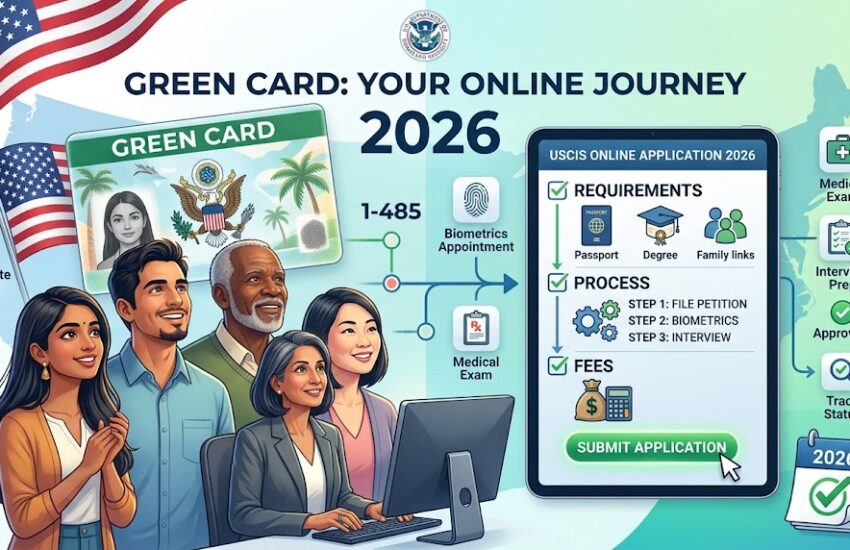
 Learn how to get a green card apply online in the USA in 2026. This complete guide explains Green Card eligibility, requirements, documents, application process, fees, interviews, medical exams, and more.

How to green card apply online in the USA in 2026: Complete Guide, Requirements, Process and Fees
Focus Keyword: how to get a Green Card in USA
SEO Title: How to Get a Green Card in the USA in 2026: Complete Guide
Suggested URL Slug:how-to-get-green-card-in-usa
Article Category: Immigration / USA Immigration
How to Get a Green Card in the USA in 2026
A Green Card, officially called a Permanent Resident Card, is an important immigration document that proves lawful permanent resident status in the United States.
A lawful permanent resident generally has the right to live permanently in the United States and work legally, subject to U.S. immigration laws and the conditions of their status.
For many immigrants, getting a Green Card is also an important step toward eventually becoming a U.S. citizen.
However, getting a Green Card is not a single process that is the same for everyone. Your application process depends on why you qualify for permanent residence, such as through a family member, employment, humanitarian protection, or another eligible immigration category.
[IMAGE: Professional illustration of a U.S. Green Card, American flag, USCIS building, and a person applying for permanent residence]
In this complete guide, we explain how to get a Green Card in the USA, who may qualify, which forms are commonly used, what documents may be required, how the process works inside and outside the United States, and what applicants should know about Green Card fees and validity.
What Is a Green Card?
A Green Card is the common name for the Permanent Resident Card issued by U.S. Citizenship and Immigration Services (USCIS).
It is evidence that a person has lawful permanent resident status in the United States.
A Green Card holder can generally:
- Live permanently in the United States
- Work legally in the United States
- Travel internationally, subject to immigration rules
- Sponsor certain qualifying family members for immigration
- Potentially apply for U.S. citizenship when eligible
A Green Card is not the same as U.S. citizenship. Permanent residents have important rights and responsibilities, but they do not have all the rights of U.S. citizens.

Who Can Get a Green Card?
There is no single Green Card application available to everyone.
You must qualify under a specific immigration category.
Common Green Card pathways include:
1. Family-Based Green Card
A U.S. citizen or lawful permanent resident may be able to petition for certain qualifying relatives.
Depending on the relationship, this can include:
- Spouse
- Children
- Parents
- Unmarried sons or daughters
- Married sons or daughters
- Brothers or sisters in certain circumstances
The exact eligibility rules depend on the relationship between the petitioner and the beneficiary.
[IMAGE: Family-based Green Card infographic showing spouse, parents, children, and siblings]
2. Employment-Based Green Card
Some people may qualify for permanent residence through employment.
Employment-based immigration categories can include:
- Priority workers
- Professionals with advanced degrees
- People with exceptional ability
- Skilled workers
- Professionals
- Certain other workers
- Certain immigrant investors
The requirements vary significantly by employment category.
3. Humanitarian-Based Categories
Certain people may become eligible for permanent residence through humanitarian or special immigration programs.
Examples can include certain:
- Asylees
- Refugees
- VAWA self-petitioners
- Special immigrants
- Other humanitarian categories
Eligibility requirements are different for each program.
4. Other Immigration Categories
There are additional Green Card pathways under U.S. immigration law.
Therefore, it is important to determine your specific immigration category before choosing a form or filing strategy.

How to Get a Green Card in the USA: Step-by-Step Process
The Green Card process depends on your immigration category, but many applications generally follow a series of important steps.
Step 1: Determine Your Eligibility
The first step is to determine which Green Card category you qualify for.
For example, a person with a qualifying U.S. citizen spouse may have a family-based pathway, while an eligible worker may qualify through an employment-based category.
Do not simply choose a Green Card form because you want permanent residence. The form must match a valid immigration category.
Step 2: File the Appropriate Petition
For many family-based cases, the U.S. citizen or lawful permanent resident petitioner files Form I-130, Petition for Alien Relative.
For many employment-based cases, an employer or qualifying petitioner may file Form I-140, Immigrant Petition for Alien Workers.
Other immigration categories may use different forms.
An important point is that approval of an immigrant petition does not automatically give the beneficiary a Green Card.
The beneficiary generally must still complete the required permanent-residence process.
Step 3: Wait for an Immigrant Visa to Become Available
Not every Green Card category has an immediately available immigrant visa.
Immediate relatives of U.S. citizens generally have visas immediately available, while many family-preference and employment-based categories are subject to annual numerical limits.
Applicants in categories with limited visas may need to wait according to their priority date and the applicable Visa Bulletin.
[IMAGE: Immigration timeline showing Petition → Priority Date → Visa Availability → Green Card Application]
This is one of the most important parts of the Green Card process because the waiting period can vary significantly by category and country of chargeability.
Step 4: Adjustment of Status or Consular Processing
There are two major ways eligible applicants may complete the permanent residence process.
Adjustment of Status
If you are already in the United States and meet the requirements, you may be able to apply for adjustment of status using Form I-485, Application to Register Permanent Residence or Adjust Status.
Adjustment of status allows an eligible person to apply for lawful permanent residence without leaving the United States.
However, eligibility depends on factors such as your immigration category, current status, manner of entry, visa availability, and other legal requirements.
Consular Processing
If you are outside the United States, or if your case is being processed through an immigrant visa abroad, the process generally involves the U.S. Department of State and a U.S. embassy or consulate.
After the immigrant visa process is completed and the person enters the United States as a permanent resident, USCIS produces and mails the Permanent Resident Card.
[IMAGE: Split infographic showing “Inside USA → Adjustment of Status” and “Outside USA → Consular Processing”]
Step 5: Submit Form I-485 When Eligible
For applicants using adjustment of status, Form I-485 is the major application used to request permanent residence.
Depending on the immigration category, Form I-485 may be filed together with the underlying immigrant petition or after the petition has been approved.
For example, certain immediate relatives of U.S. citizens may be able to file Form I-130 and Form I-485 concurrently when otherwise eligible.
Applicants in preference categories generally need to pay close attention to visa availability and the applicable Visa Bulletin.
Step 6: Biometrics Appointment
After filing, USCIS may schedule the applicant for a biometrics appointment.
Biometrics may include:
- Fingerprints
- Photograph
- Signature
USCIS uses biometric information for identity verification and background and security checks.
If USCIS sends you a biometrics appointment notice, carefully follow the instructions and bring the required identification and appointment notice.
Step 7: Attend the Interview if Required
USCIS may require a Green Card applicant to attend an interview.
The interview requirements depend on the type of case.
During an interview, USCIS may ask questions about:
- Your application
- Your immigration history
- Your relationship with the petitioner
- Your employment
- Your family
- Your eligibility for permanent residence
Not every applicant will necessarily have the same interview experience.
Step 8: Receive a Decision
After reviewing the application, supporting documents, background checks, interview information, and other evidence, USCIS may:
- Approve the application
- Send a Request for Evidence (RFE)
- Send another notice requesting information
- Deny the application
If USCIS approves the application, the applicant becomes a lawful permanent resident according to the applicable immigration process.
Green Card Document Checklist
The exact documents required depend on your immigration category and personal circumstances.
However, applicants may need documents such as:
Identity Documents
- Valid passport
- Government-issued identification
- Birth certificate
- Passport-style photographs, when required
Immigration Documents
- Visa documents
- Form I-94
- Previous immigration records
- USCIS notices
- Employment Authorization Document, if applicable
- Other immigration documents
Family-Based Documents
For family-based cases, documents may include:
- Marriage certificate
- Birth certificates
- Divorce decrees, if applicable
- Evidence of a genuine marital relationship
- Photographs
- Joint financial or household records
- Other relationship evidence
Employment-Based Documents
Depending on the employment category, evidence may include:
- Job offer
- Employment records
- Educational qualifications
- Degree certificates
- Professional licenses
- Work experience records
- Employer documentation
Financial Documents
Some family-based Green Card cases require financial sponsorship documentation, including Form I-864, Affidavit of Support.
Supporting financial evidence may include:
- Federal tax returns
- W-2 forms
- Pay statements
- Employment verification
- Other evidence of income or assets
Medical Examination and Form I-693
Some Green Card applicants who are adjusting status in the United States may need an immigration medical examination.
The examination is completed by a USCIS-designated civil surgeon, and the results are reported on Form I-693, Report of Immigration Medical Examination and Vaccination Record.
Do not use an ordinary doctor who is not authorized by USCIS to perform the immigration medical examination.
Applicants should follow the current USCIS instructions concerning when and how Form I-693 must be submitted.
[IMAGE: Immigration medical examination infographic showing doctor, vaccination record, Form I-693, and Green Card application]
What If Your Documents Are Not in English?
If a document is written in a foreign language, USCIS generally requires an English translation.
The translation must meet USCIS requirements and include the translator’s certification.
Do not simply submit an informal translation from Google Translate or an unverified translation.
Always follow the translation requirements associated with the form you are filing.

Green Card Fees in 2026
Green Card costs are not one fixed amount for every applicant.
The total cost depends on:
- Immigration category
- Forms being filed
- Whether forms are filed online or by paper
- Whether additional applications are filed
- Whether the case is processed inside or outside the United States
- Whether the applicant qualifies for a fee waiver or exemption
For example, USCIS’s current fee schedule lists the general Form I-485 filing fee for applicants age 14 or older at $1,440.
The Form I-130 fee is currently $625 when filed online and $675 when filed by paper.
Additional forms such as Form I-765 for employment authorization and Form I-131 for travel documents can have separate fees.
Because USCIS fees can change, always check the current USCIS Fee Schedule before filing.
[IMAGE: Green Card fee infographic showing I-130, I-485, I-765 and I-131 with a “Check Current USCIS Fees” warning]
Is There a Green Card Application Fee?
Yes.
Most standard Green Card applications involve government filing fees, although some applicants or categories may qualify for fee exemptions or fee waivers.
You should never assume that every Green Card application costs the same amount.
Before sending an application, check the official USCIS fee information for the exact forms and category involved.
How Long Does It Take to Get a Green Card?
There is no single processing time for every Green Card application.
Processing time can depend on:
- Form type
- Immigration category
- USCIS office
- Country of chargeability
- Visa availability
- Priority date
- Background checks
- Requests for Evidence
- Interview requirements
- Other case-specific circumstances
Some categories can involve significant visa backlogs.
Applicants should use the official USCIS processing-time tools and, where applicable, the Department of State Visa Bulletin rather than relying on a fixed number of months advertised by a private website.
Green Card Validity
A standard Permanent Resident Card is generally issued with a 10-year expiration date.
However, the expiration of the physical card is not the same thing as automatically losing permanent resident status.
If your Green Card is expiring, you may need to apply for a replacement or renewal according to USCIS procedures.
What Is a Conditional Green Card?
Some people receive conditional permanent resident status instead of standard permanent resident status.
For example, certain people who obtain permanent residence through marriage may receive conditional residence if they have been married for less than two years at the relevant time.
A conditional Green Card is generally valid for two years.
Conditional residents must follow the appropriate process to remove the conditions before the conditional period ends.
The procedure depends on the basis for the conditional residence.
[IMAGE: Comparison infographic showing “10-Year Green Card vs 2-Year Conditional Green Card”]
Green Card vs. U.S. Citizenship
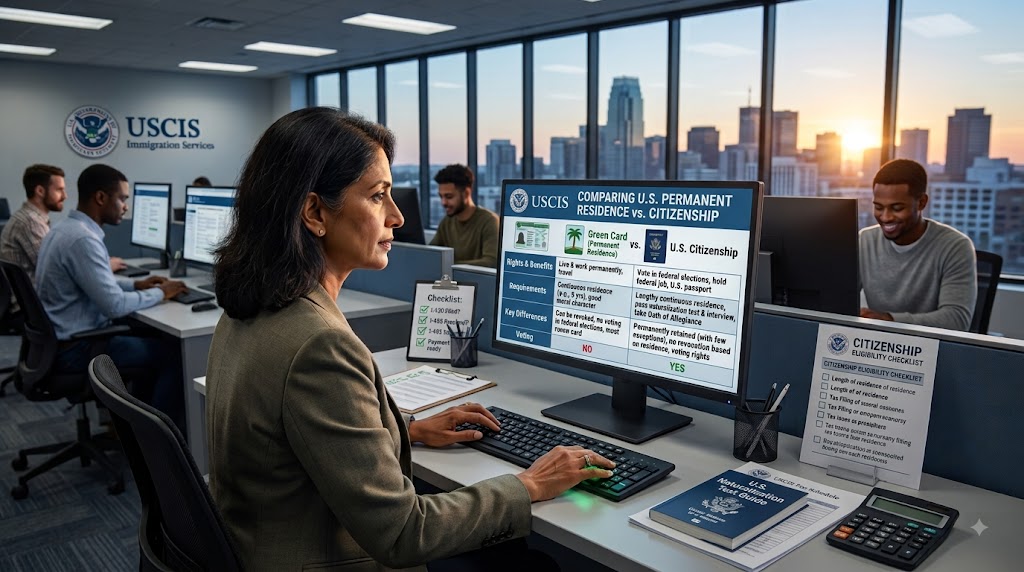
A Green Card does not make someone a U.S. citizen.
A lawful permanent resident may later become eligible to apply for U.S. citizenship through the naturalization process if all applicable requirements are met.
Citizenship requirements can depend on factors such as:
- Length of permanent residence
- Continuous residence
- Physical presence
- Good moral character
- English and civics requirements
- Other eligibility rules
Therefore, Green Card holders should understand that permanent residence and citizenship are two different immigration statuses.
Common Green Card Mistakes to Avoid
1. Using the Wrong Form
Do not file a form without first determining your immigration category.
2. Using Outdated Forms
USCIS periodically updates its forms.
Always download the current version from the official USCIS website before filing.
3. Missing Supporting Documents
A missing document can cause delays, an RFE, or potentially a denial.
4. Paying the Wrong Fee
USCIS fees vary by form and filing method.
Always verify the current fee before submitting your application.
5. Providing False Information
Never provide false information or fake documents.
False statements or fraudulent documents can have serious immigration consequences.
6. Ignoring Your Priority Date
If your category is subject to a visa quota, your priority date can be extremely important.
Check the applicable Visa Bulletin and USCIS filing-chart instructions.
7. Missing USCIS Notices
Always keep your mailing address updated and monitor your USCIS case.
How to Check Your Green Card Case Status
After submitting an immigration application or petition, you may receive a USCIS receipt notice containing a receipt number.
You can use the official USCIS case-status system to check your case.
Keep your receipt notices and other USCIS correspondence in a safe place.
[IMAGE: Laptop showing USCIS Case Status Online with a Green Card application tracking number]
Official USCIS Website for Green Card Applications
The official website for U.S. immigration applications is:
USCIS.gov
USCIS provides information about:
- Green Cards
- Immigration forms
- Filing fees
- Case status
- Processing times
- Biometrics
- Interviews
- Immigration medical examinations
- USCIS online accounts
Always use the official USCIS website when checking current requirements.
Frequently Asked Questions About Green Cards
What is a Green Card?
A Green Card, officially called a Permanent Resident Card, is evidence of lawful permanent resident status in the United States.
How can I get a Green Card in the USA?
You must qualify under an eligible immigration category, such as family-based, employment-based, humanitarian, or another qualifying category. The exact process depends on your situation.
How much does a Green Card cost in 2026?
There is no single Green Card fee. The cost depends on the forms and immigration process involved. For example, the general I-485 filing fee is currently $1,440 for applicants age 14 or older, while I-130 fees vary depending on whether it is filed online or by paper.
Can I get a Green Card through marriage?
Marriage to a U.S. citizen or lawful permanent resident may provide a family-based immigration pathway, but marriage alone does not automatically grant a Green Card. The applicant and petitioner must meet applicable immigration requirements.
Can I get a Green Card through a job?
Some workers may qualify for employment-based permanent residence. The requirements depend on the employment category and may involve an employer petition and other requirements.
Do I need a medical examination?
Some applicants adjusting status in the United States must complete an immigration medical examination using a USCIS-designated civil surgeon and Form I-693.
How long is a Green Card valid?
A standard Green Card is generally valid for 10 years. Certain conditional permanent residents receive cards valid for two years.
Does a Green Card make me a U.S. citizen?
No. A Green Card provides lawful permanent resident status, not citizenship.
Can Green Card holders work in the USA?
Generally, lawful permanent residents are authorized to work in the United States.
Can I travel outside the United States with a Green Card?
Permanent residents can generally travel internationally, but extended or repeated absences can create immigration issues. Before taking a long trip, understand the rules that apply to maintaining permanent residence.
Final Thoughts
Getting a Green Card can be a major step toward building a permanent life in the United States, but the process depends heavily on your individual immigration category.
Whether you qualify through a family member, employment, humanitarian protection, or another immigration program, you should first determine the correct eligibility category and then follow the USCIS instructions for the appropriate forms and supporting documents.
Do not rely on outdated Green Card fee information or generic promises about processing times. USCIS requirements, forms, fees, and procedures can change.
For the most accurate and current information, always check the official USCIS website before submitting an application.
Watch Our Green Card Video
Want to understand the Green Card process more easily?
Watch our complete video guide to learn about:
- What a Green Card is
- Who can qualify
- Family-based Green Cards
- Employment-based Green Cards
- Form I-130
- Form I-140
- Form I-485
- Adjustment of Status
- Consular Processing
- Required documents
- Medical examination
- Green Card fees
- Biometrics and interviews
- Green Card validity
- Common mistakes to avoid
[VIDEO EMBED: Insert your Green Card YouTube video here]
Stay Connected With Gackvel
For more helpful guides about U.S. immigration, jobs, government services, finance, technology, and other useful information, visit Gackvel.com.
If this guide was helpful, subscribe to our YouTube channel for more easy-to-understand guides and updates.
Website: Gackvel.com
Disclaimer
This article is provided for general informational purposes only and does not constitute legal advice or create an attorney-client relationship.
U.S. immigration laws and USCIS procedures can change. Eligibility and required documents vary from person to person and from one immigration category to another.
Always verify the latest requirements, forms, filing fees, and instructions directly with USCIS or consult a qualified U.S. immigration attorney for advice about your specific case.
SEO Keyword List
Primary Keyword:
how to get a Green Card in USA
Secondary Keywords:
- how to get a Green Card
- how to apply for a Green Card
- Green Card USA
- Green Card application
- Green Card requirements
- Green Card process
- Green Card application 2026
- Green Card fees 2026
- Green Card eligibility
- Green Card documents
- how to apply for Green Card in USA
- U.S. Green Card
- Permanent Resident Card
- permanent residence USA
- lawful permanent resident
- Green Card through marriage
- marriage Green Card
- family based Green Card
- employment based Green Card
- Green Card through employment
- USCIS Green Card
- USCIS Green Card application
- Form I-130
- Form I-140
- Form I-485
- Adjustment of Status
- Consular Processing
- Green Card medical exam
- Form I-693
- Green Card interview
- Green Card biometrics
- Green Card renewal
- conditional Green Card
- 10 year Green Card
- 2 year Green Card
- Green Card USA 2026
Long-Tail SEO Keywords
- how to get a Green Card in USA in 2026
- how to apply for a Green Card in USA
- Green Card application process step by step
- Green Card requirements for immigrants
- how to get permanent residence in USA
- how to get Green Card through marriage
- how to get Green Card through employment
- documents needed for Green Card application
- how much does a Green Card cost in 2026
- Green Card fees in USA 2026
- how long does it take to get a Green Card
- how to apply for Green Card from inside USA
- Green Card consular processing from outside USA
- Form I-485 Green Card application
- Form I-130 family Green Card
- USCIS Green Card requirements 2026
How to redirect posts WordPress
Suggested Image Placement
Image 1 — Featured Image:
U.S. Green Card + American flag + USCIS building
ALT: How to Get a Green Card in the USA in 2026
Image 2:
Family-based Green Card infographic
ALT: Family Based Green Card USA
Image 3:
Adjustment of Status vs Consular Processing
ALT: Green Card Adjustment of Status vs Consular Processing
Image 4:
Green Card document checklist
ALT: Documents Needed for Green Card Application
Image 5:
Green Card fees infographic
ALT: Green Card Fees USA 2026
Image 6:
10-year vs 2-year conditional Green Card
ALT: Green Card Validity 10 Years vs Conditional 2 Years
Image 7:
USCIS case status screen
ALT: Check Green Card Case Status Online
Article के लिए सबसे अच्छा SEO setup
Primary keyword: how to get a Green Card in USA
SEO title: How to Get a Green Card in the USA in 2026: Complete Guide
URL: gackvel.com/how-to-get-green-card-in-usa/
Featured image text:
HOW TO GET A GREEN CARD?
USA 2026 COMPLETE GUIDE
Official sources: USCIS — Green Card Information · USCIS — Fee Schedule · USCIS — Case Status